|
|
|
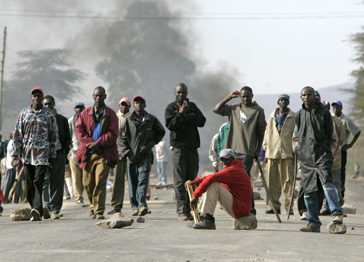
NAIVASHA, KENYA — Some 2,000 people from rival tribes faced off on a main road on Monday in this previously quiet tourist town, divided only by a handful of police who fired into the air to force their retreat. Some 208 kilometres away from the violence in Naivasha, in the city of Kisumu on the shore of Lake Victoria, rioting mobs torched houses and buses and blocked blood-spattered roadways. Ethnic clashes sparked by a disputed presidential election a month ago have claimed the lives of 800 people, spreading into the fertile Rift Valley. The fighting began after President Mwai Kibaki's Dec. 27 re-election, which international and local observers say was rigged. About 255,000 people have been forced from their homes. "This is Kikuyu land!" was the cry in Naivasha from one side, which called for revenge against the rival Luo tribe. "We want peace, but we (also) want to fight them," said Peter Mwangi, a 20-year-old acrobat. "We don't want Luos here." EU foreign ministers threatened to suspend development aid unless Kenya's rival political factions agree to a power-sharing pact and restore stability, saying the bloc "cannot conduct business as usual with Kenya." In a declaration, the ministers backed warnings by EU Development Commissioner Louis Michel, who has said that long-term development aid to Kenya — about $563-million (U.S.) over five years — could be at risk. Only about 6 per cent of Kenya's budget comes from foreign aid and the government has said it will not be blackmailed over it. The United States has said it would not threaten to cut aid. In Washington, State Department spokesman Sean McCormack said Kenya has "gone from bad to worse, in terms of the violence. That underscores the urgent need for these two political leaders to come to a political agreement. The root cause of the violence is political tension." In Kisumu on Monday, young men blocked roads out of the town with burning tires and rocks. "Kikuyus must go!" "No Raila, no peace!" they yelled, referring to the tribe of Mr. Kibaki, and to his chief rival, opposition leader Raila Odinga. Members of Odinga's Luo tribe are among those challenging the official election results, and in Kisumu some of them took out their rage on Kikuyus, including a bus driver who was burned to death inside his minibus, according to Lillian Ocho, who saw the destruction. "The road is covered in blood. It's chaos. Luos are hunting Kikuyus for revenge," said Baraka Karama, a journalist for independent broadcaster Kenya Television. Kenya's Rift Valley, scene of the worst postelection violence, is dominated by the Kalenjin and Masai tribes but has pockets of population from all over the country. Many of them, especially Kibaki's Kikuyu people, settled there in the 1960s under controversial land resettlement schemes that have caused deep resentment. The bloodshed has transformed this once-stable African country, pitting neighbours against one another and turning towns where tourists used to gather for luxury holidays into no-go zones. Britain's visiting minister for Africa, Mark Malloch-Brown, said the latest violence appeared to be orchestrated. "What is so alarming about the last few days is ... there's evidently hidden hands organizing it now," he said. Mr. Kibaki's government sought to capitalize on Mr. Malloch-Brown's visit, putting out a statement after the meeting headed "British Government recognizes President Kibaki and his Government." British Embassy spokeswoman Charley Williams said Britain recognizes states, not governments. Mr. Kibaki has received congratulatory messages on his re-election from only seven countries, according to Kenya's Foreign Affairs Ministry: Iran, Kuwait, Morocco, Rwanda, Somalia, Swaziland and Uganda. At least 22 people were killed in Naivasha over the weekend, said district commissioner Katee Mwanza. Nineteen of them were Luos whom a gang of Kikuyus chased through a slum and trapped in a shanty that they set on fire, said police commander Grace Kakai. The others were hacked to death with machetes, a local reporter told The Associated Press. In Kakamega, gangs of youths looted and set ablaze a downtown hotel and two wholesalers, the Rev. Allam Kizili of the Pentecostal Church said. Police fired tear gas to try to stop the violence, he said. The violence is complicating mediation efforts by Former U.N. Secretary-General Kofi Annan. "Negotiations are becoming more and more difficult because the level of anger between the two sides is just growing exponentially," Mr. Malloch-Brown told reporters. "The two sides are very far apart at this time." He said that Mr. Odinga appeared eager for international mediation to succeed but "the government feels the situation is being manipulated and internationalized to weaken its control." Mr. Kibaki has said he is open to direct talks with Mr. Odinga, but that his position as president is not negotiable. Mr. Odinga says Mr. Kibaki must step down and only new elections will bring peace. After meetings Sunday, opposition spokesman Salim Lone said the two leaders were asked to name three negotiators for the talks, which he said he would hopefully start "within a week." On Sunday, looters used iron bars to smash the windows of shops belonging to non-Kikuyu business people, and made off with television sets, groceries and clothing. One woman came screaming down the road from a blazing house. "They set it on fire, they are killing my brother and sister," Alice Okoth said. Two-thirds of the town of Timboroa was set ablaze in a pre-dawn attack Sunday that witnesses said left four dead. Elsewhere, in Nakuru, the provincial capital of Kenya's fertile Rift Valley, 64 bodies were counted Monday at the morgue, said a worker who asked that his name not be used because he was not authorized to speak to the media. Ethnic clashes broke out there Thursday. National police Commissioner Hussein Ali told reporters in Nairobi that police had arrested 159 people in Nakuru and Naivasha "for possession of crude weapons and for suspected involvement in the murders." He also said 95 people were arrested in Nairobi, but gave no details. |
|