The diversion of water for the Beijing Olympics threatens the livelihoods of millions of people, a senior Chinese government official has said.
The official, An Qiyuan, from Shaanxi province, told the UK's Financial Times newspaper that people in north-western provinces should be compensated.
He warned of social upheaval and environmental harm because of the strain put on local water supplies.
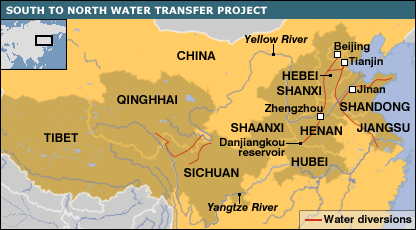
China is building a huge network to divert water to the north.
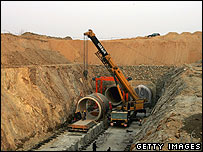
The project will divert water from rivers in the south via tunnels, dams and canals to cities in the north where consumption is at an all-time high.
South to North Water transfer project
Part of the massive project was brought forward to provide water for the Olympics in the summer.
Mr An, a member of the Chinese People's Political Consultative Committee in Shaanxi, said the diversion of water supplies would have a severe effect.
Factories closed
"In order to preserve the quality of Beijing's water we have to close all our factories," he said.
"But we still need to live. So I say the government needs to compensate Shaanxi."
Mr An, formerly Communist Party chief in Shaanxi, was also critical of the huge Sanmexia Dam, constructed in the 1950s.
The project is blamed for the Yellow River silting up and causing flooding - something it was meant to avoid.
"It was so stupid, stupid," said Mr An.
Correspondents say it is unusual for a leading communist official to be so openly critical of government policy.
National network
Shaanxi and Hebei province are being required to pump clean water to Beijing in time for the Olympics.
Much of the extra water for Beijing will come from the Yellow River
|
They are on the northern stretch of a much larger water transfer project designed to bring supplies from the Yangtze River in the south to thirsty northern industrial areas, including Beijing.
The entire project, costing tens of billions of dollars, is due for completion by 2010, but the authorities in the capital are hoping the northern leg of the network will be ready in time for the Olympics.
Experts say water demand could rise to 30% above average in the city as thousands of visitors arrive for the games.
Hebei
Hebei province, which lies next to Beijing and supplies most of its water, is suffering from severe drought, the official Hebei Daily reported on Tuesday.
Officials in the province were quoted as saying the drought, caused by a lack of rain and snow, meant the "conflict between water supply and demand has been dramatically exacerbated".
Hebei province is being asked to provide an extra 300m cubic metres of back-up supplies to Beijing's 16 million residents as the Games approach.
Several hundred kilometres of pipe and channels are being constructed in the province to supply the capital. But farmers complain that lack of water is already severely undermining agricultural land.
The Hebei Daily reported that 33,000 sq km (12,740 sq miles) of farmland was now affected by drought, while a quarter of a million residents were facing problems with drinking water.