|
|
|
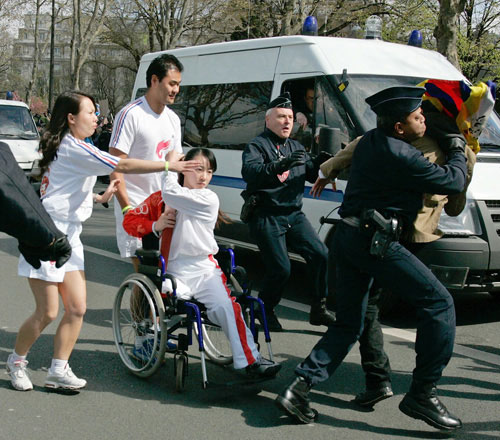
Her fans describe her as fearless and modest. "She has captured the hearts of millions of Chinese people," the state news agency says. As for Ms. Jin, she smiles sweetly and then says, of the protesters, "I despise them." China in 2008 has become a story with two dramatically contrasting narratives, each isolated in its own solitude, almost unaware of the other. While the West sees the Chinese government as the violent oppressors of Tibetans and other dissidents, the Chinese see their country as the victim of external attacks, and the "wheelchair angel" is their ultimate symbol. After initially censoring the televised reports on the torch protests in London and Paris, the Chinese government soon found it better to encourage the reports, which were carefully edited to portray China as the victim. Last month, the state media gave huge publicity to another iconic image of the Tibet crisis: the five young Chinese saleswomen who were killed in their clothing shop in Lhasa when it was set ablaze by Tibetan protesters. Again, the Chinese saw their women as innocent victims of Western-supported attackers. With images such as those to mould the national mood, it has been surprisingly easy for China's autocratic rulers to rally their country to support them. And here is the unexpected reality of the Chinese Communist Party in 2008: Its international image might be bruised and battered, but its internal grip on power is stronger than ever. There is mounting evidence — in Internet chat rooms, on the streets and everywhere else where public opinion can be measured — that the Chinese Communist Party has gained popularity and strength as a result of the violence and chaos of the past month. It might be facing an Olympic opening ceremony boycott and mounting criticism from abroad, but the government has largely succeeded in mobilizing its 1.3 -billion people into a unified force, giving it the domestic legitimacy it craves for its survival. "Thanks to the protests, the Chinese Communists may have consolidated support by its citizens for years to come," says Roland Soong, a shrewd observer of Chinese politics who runs a blog analyzing the Chinese media. "For the Chinese Communists, the responses from Western governments, media and citizens are immaterial," he wrote in his blog. "The paramount goal of the Chinese Communists is to retain control of China, and therefore it is the response from the Chinese citizens that matter." The legend of Jin Jing has been a huge coup for Beijing in its efforts to exploit the torch protests for its own self-interest, Mr. Soong says. "Faced with the beautiful heroine with one leg, how is any liberal dissidence on behalf of Tibet going to work inside China? This was a bonanza handed to the Chinese Communists by the pro-Tibet protesters." In many ways, Tibet and the Olympics were the ideal issues for Beijing to face, if it was going to face any crisis in 2008. Western activists may have inadvertently blundered by choosing these two issues as the focus of their strategy this year. Ethnic minorities rarely get much sympathy among China's people. Tibet and the Olympics are relatively simple for Beijing to frame as an "us-against-them" narrative, in almost tribal terms, drawing upon China's painful memories of foreign attacks from the Opium Wars to the Japanese invasions. "The Chinese government has been able to strengthen its credentials as a defender of Chinese nationalistic pride," said Charles Burton, a former Canadian diplomat in Beijing who is now a political scientist at Brock University in St. Catharines, Ont. "People who were not fully supportive of the Communist Party's rule have now united strongly around the party's political agenda for Tibet. The attacks on the Olympic flame have polarized the differences between China and the West, and the West is much more demonized than before." This political dynamic has changed drastically in the past two decades. In 1989, there was huge Chinese sympathy for the university students who held hunger strikes at Tiananmen Square to seek freedom and oppose corruption. Most of the Tiananmen protesters were of the same Han Chinese ethnicity as the national majority. As university students, they were the best and brightest, the hope of the nation, and they garnered much sympathy from across the country. But in 2008, in a growing climate of nationalism after years of "patriotic education" in the schools and media, there is little sympathy, and much hostility, toward the Tibetan protesters who live abroad or in their remote ethnic enclave. The Tibetan "splittists" are widely portrayed as uncivilized, violent, anti-Chinese, ungrateful for the government's help and controlled by foreign agitators. For the Han majority, the Tibetans are often seen as outsiders who even fought wars against China in the past. Their support from the West makes them even more hostile in Chinese eyes. The Olympics, too, are seen as an "us-against-them" story. Foreign activists and boycott advocates are seen as malicious enemies who want to destroy the moment of China's greatest pride and prestige. And so, while the Tiananmen Square protests rocked the Chinese leadership in 1989, the Tibet crisis of 2008 has had the opposite effect: It has strengthened the government's hand. "In a crisis, the nationalist card is one of the most potent that the government can play," said Willy Lam, a long-time China watcher and political analyst based in Hong Kong. "If you read the Chinese websites, there is a campaign of hatred against the Tibetans," he said. "I think it works. It enables the leadership to divert attention from the mistakes that they have made." Despite China's toughest crisis in years, its rulers have shown far more resilience than many expected. They have won support from the country's influential middle classes, who have profited from the economic boom of recent years. They have learned how to manipulate events to create public outrage and pro-government feelings. And they have learned how to benefit from the high-speed communications technology that is now ubiquitous in China. The technological tools that were supposed to democratize China — websites, blogs, video sites and slickly produced television channels — are actually bolstering the Communist government by allowing it to mobilize anger at foreign critics. Howard Balloch, a former Canadian ambassador to China who now heads an investment bank in Beijing, says the Chinese government is worried about the international reaction to its handling of the Tibet crisis and the torch relay, but not the domestic reaction. "I think they know that the people support them on this," he said in an interview. "It has buttressed their support across the whole country. I don't think they are worried about it." External pressure on an authoritarian regime often has the unintended effect of boosting the regime's domestic power. Sanctions and embargos actually helped to strengthen the internal popularity of autocrats and dictators such as Saddam Hussein, Fidel Castro, Slobodan Milosevic and the mullahs of Iran. Although some were eventually ousted, the sanctions helped them to extend their rule for years. They were able to portray themselves as the victims of hostile foreign powers, and their populations rallied around them. The foreign protests against China this spring are creating the same rally-round-the-leader phenomenon. The irresistible saga of Jin Jing, the wheelchair angel who had part of her right leg amputated at the age of 9 because of cancer, has been useful in stoking the emotions of patriotism and victimhood in China — especially since there is a distinct lack of personal charisma among the relatively faceless members of China's Politburo. The Chinese Internet is buzzing with thousands of homages to Ms. Jin, linking her to the fate of the nation. Many vowed to kill the protesters who had tried to seize the Olympic torch from her. "Jin Jing, you are pretty, but your heart is even prettier," one person wrote. "We all support you. Long live the motherland!" A blog by one of her torch-relay companions said: "Let the storm be even stronger! Our heroes are unafraid. Victory will be ours in the end!"
|
|