|
|
|
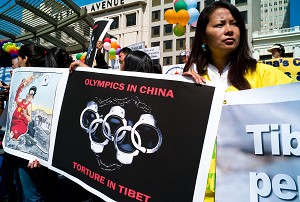
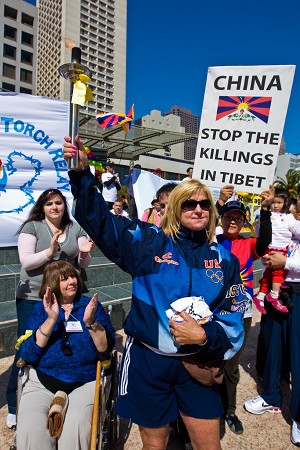
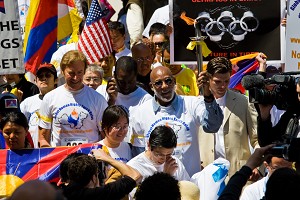
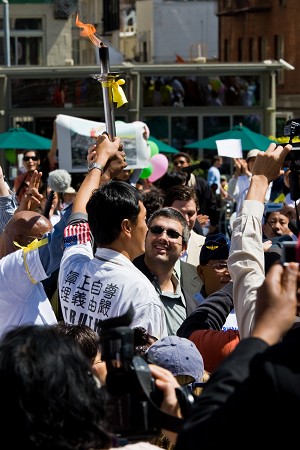
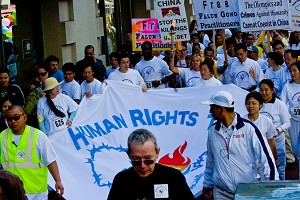
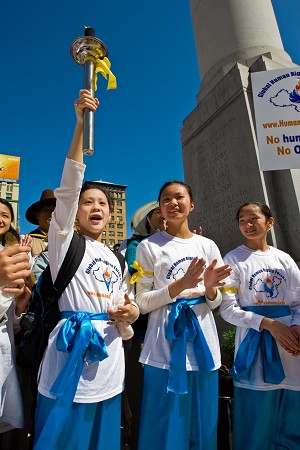
SAN FRANCISCO—On a sunny, breezy Saturday, San Francisco's Union Square hosted the Human Rights Torch Relay (HRTR)—a grassroots campaign with the mission of bringing awareness to the global community of the vast list of human rights violations that the Chinese regime is guilty of. In doing so, the Human Rights Torch has set the stage for the official Olympic torch, which is due to arrive in San Francisco on Wednesday. The rally in Union Square made the case for the HRTR slogan: "The Olympics and crimes against humanity cannot coexist in China." San Francisco will be the only city in the U.S. to host the Beijing torch, but not with open arms, as the Chinese regime might have expected. A resolution, sponsored by Supervisor Chris Daly, was passed last week by the San Francisco board of supervisors. It says that the city of San Francisco should welcome the torch "with alarm and protest." It is a resolution worthy of the city renowned for its respect for personal beliefs and tolerance. Mayor Gavin Newsom's office had declined an invitation to attend the HRTR event, his recent mantra about the Olympics being that the "Olympics are not about politics." At the HRTR rally, speakers, from varied perspectives and personal experiences, spoke about how the Olympic movement cannot be divorced from considerations of human rights.
The sizable crowd in the hundreds that filled Union Square listened attentively to remarks from government officials, former Olympians, medical professionals, musicians, Tibetans, Falun Gong practitioners, Catholics, and Uighur Muslims in China, labor advocates decrying sweatshop practices in China and the U.S. businesses that support them, and spokespersons for countries directly affected by China's influence over them, including Darfur, Tibet and Burma. Many were moved to tears by heartfelt appeals and information they had previously been aware of. The common ground of all the diverse groups present was the need to address the moral dilemma that the International Olympics Committee (IOC) has triggered by awarding the 2008 Summer Olympics to a regime with such a disastrous human rights record.
Before the Chinese regime was granted the right to host the Olympic Games, it agreed to improve its human rights practices. But with the impending Games in August rapidly approaching, much to the contrary, these violations have been dramatically escalating. The government's recent ruthless crackdown on the Tibetan people in China and the recent sentencing of the human rights lawyer Hu Jia to three years in prison convey the message that the Chinese regime will do what it pleases, no matter what promises it has made regarding human rights. Analogies made to the 1936 Olympic Games in Germany and other Olympic human rights disasters were persistent themes throughout the program. Before the ceremony began, The Watsonville Taiko drummers, directed by Ikuyo Conant, entertained the group with its driving beat. Other groups were the Randall Effner duo, Jack Chernos, vocalist, and the Ramana Vieira Band, which had entertained at the Olympics in Madrid via satellite.
Supervisor Chris Daly was the opening speaker, expressing in depth the responsibility that we all have to set the wrongs of the world right. He has long been a human rights advocate regarding China, having sponsored various resolutions through the San Francisco Board of Supervisors. Renowned human rights lawyer David Matas traveled from Canada to participate in the event. He and fellow Canadian David Kilgour co-authored a report on their findings about the illegal organ harvesting of Falun Gong practitioners in China. The report concludes that tens of thousands of Falun Gong have been killed for their organs, which is a billion dollar business for China. He presided over an afternoon forum about the report. Tatiana Kostanian is a dialysis patient who is on the mayor's Council for the Disabled. She knows of no potential recipient for a transplant who would even think of going to China for a transplant and remarked that members of the Chinese regime are "betrayers of humankind," whose pictures and crimes will be immortalized in history books. Li Bin, a Falun Gong pracititioner from Los Angeles, also shared her moving account of torture and imprisonment in China, and the urgency to rescue those whose lives are in extreme danger in China. Dr. Alejandro Centurion shared his insights on the extensive criminal practice of organ harvesting in China.
Other medical professionals included bay area psychologist, Jim Wilson, who represents Friends of Gao Zhisheng. Gao, a famous human rights lawyer from China, composed a 12-page letter to the U.S. Congress last year. Two days later, he disappeared. Physician Ahimsa Porter Sumchai spoke of the myriad transgressions throughout the world committed by the Chinese regime, and their indisputable interconnectedness. John Carlos, 1968 Olympic bronze medalist in Mexico City, spoke of the racial human rights issues that prevailed in the U.S. at that time, which made his achievement all the more significant. Before the Games, the IOC told Mexico City to "clean house," and that mandate resulted in 350 deaths. He quoted Dr. Martin Luther King on the need to overcome not just the oppression of the bad people, but the "appalling silence of the good people." He concluded by saying, "we need to work together or explode together." (John Carlos and fellow Olympian, Tommie Smith, both San Jose University students, stood on the Olympic podium in 1968, each raising a fist, in tribute to Black-American human rights.)
Lynn Vidali Gautschi, Olympic medalist in the 1968 and 1972 Games, shared with the crowd one of the saddest days of her life: the day of the Munich massacre in 1972. Since the Games are obviously more about governments and not about people, she urged people not to criticize the Olympic aspirants for pursuing their dreams, for which they have worked so hard for. Former Chinese national basketball player Kai Chen paid homage to the student uprising in Tiananmen Square in 1989. He called upon China's basketball superstar Yao Ming not to bear the Olympic torch for China. A letter from House Speaker Nancy Pelosi was read to the rally. It related her original request in 2001 to Congress that the Olympic Games not take place in China, due to excessive human rights violations. She supports the right of all to protest peacefully when the Beijing torch arrives in San Francisco. Congresswoman Barbara Lee also expressed her support in a letter. As a member of the newly created Tibetan Caucus, she has sponsored a bill to prevent government officials from going to the Games at the expense of the taxpayers and has urged President Bush not to attend the Games. Local city council members Charles Marsala of Atherton, Paul V. Morris, of San Pablo, and Criss Worthington of Berkeley were present to express their support for the event. Morris strongly urged individuals to write their officials, expressing, from his own experience, that such efforts would not go unnoticed. Individuals from countries directly affected by the Chinese government spoke. Representing Darfur, Mr. Mohamed Suleiman lost his entire family, due to the genocide in Darfur sponsored by the government of Sudan. (The Chinese government supports that government, providing arms to the country and the treacherous Janjiaweed militia.)
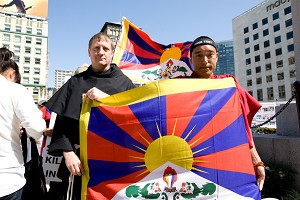
A Tibetan monk in attendance spoke of how the claims by the Chinese government that the Dalai Lama orchestrated the recent uprisng in Lhasa are baseless. He commented that if someone could do that from the outside, then "shame on China: you failed to protect your people." With regard for the regime's penchant for staging events, we need to "come together to find a way to stop the Beijing torch from going to Tibet," which would be "absolute disaster." He said the Tibetan way has always been through peace and non-violence, and its weapon is truth. Phu Nguyen, president of the Vietnamese Veterans Association of San Francisco, also expressed his concern for countries such as Burma, Vietnam and Tibet, which he described as "puppet regimes" at the hands of China's regime. Also expressing concern for Vietnam was Tien Nguyen, President of the Northern Vietnamese Community, from San Jose, and Tan Nguyen, chairman of the American Vietnamese community, who had travelled from Washington, D.C. to participate.
Investigative journalist for the Los Angeles Times Theresa Marie Moreau spoke about the plight of persecuted Catholics in China, and to convey the message to them, "you are not forgotten." Medea Benjamin, Cofounder of CODEPINK and Global Exchange, spoke of the extreme hardships endured by sweatshop workers in China, who are often underage and far from home. Many of the posh stores in the U.S., including those surrounding Union Square, profit handsomely from such labor that is not fairly compensated, which consequently devalues the world's workers, as well. Since Chinese workers do not have the right to form independent unions, they are at the whim and mercy of unscrupulous employers, another form of persecution. At the conclusion of the speeches, Olympians Vidali and Kai Chen, carrying the torch together, initiated a 6K run, with enthusiastic runners queued up behind them. The route went from Market Street to the Ferry Building, along the Embarcadero to Pier 39, encompassed North Beach and the heart of Chinatown, and returned to Union Square. Upon their return to Union Square, they concluded the day's activities by passing the torch among an intimate circle, intent on making a difference through spreading its light in society, rather than cursing the darkness. They congratulated each other for caring, vowing to let others know of the widespread crimes committed by the Chinese government, and why such crimes and the Olympic Games don't mix.
|
|