|
|
|
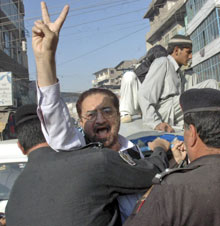
The government disputed the figure Monday, but acknowledged that up to 1,800 people have been detained. The U.S. government urged Musharraf to release those arrested and return to a constitutional path. White House spokeswoman Dana Perino said Monday the U.S. government was "deeply disturbed" by Musharraf's imposition of emergency rule on Saturday, Reuters reported. "We believe that the best path for Pakistan is to quickly return to a constitutional path and then to hold elections," U.S. Secretary of State Condoleezza Rice said earlier in the day. Rice also urged Musharraf to follow through with past promises to "take off his uniform." A spokesman for former prime minister Nawaz Sharif's party said Monday that authorities had rounded up around 2,300 of its supporters, the Associated Press reported. Other opposition parties, human rights groups and lawyers said another 1,200 people had also been arrested. Musharraf, who took power in a 1999 coup and is also the head of the country's army, suspended the constitution Saturday ahead of a Supreme Court ruling on whether his re-election in October was legal. Election to go ahead as plannedOver the weekend, Musharraf ousted the country's top judge, deployed troops to fight what he calls Islamic extremism and imposed a number of other restrictions, such as stripping media freedoms. In response to the emergency rule, Washington said it is reviewing billions of dollars in aid to Pakistan, which has received about $11 billion from the U.S. since 2001, when it became a close ally in the so-called War on Terror. President George W. Bush's top national security aides, however, said financial backing for counterterrorism efforts will likely continue uninterrupted. Under mounting pressure from Western countries, the Pakistan government announced Monday a general election will be held by mid-January as planned. Over the weekend, the government had said the elections could be delayed up to a year. "It has been decided there would be no delay in the election," Attorney General Malik Abdul Qayyum said, according to Reuters. By Nov. 15, he said, the national and provincial assemblies will be dissolved and an election will be held within the next 60 days. Police crack down on protestsOn Monday, police officers using tear gas and batons dispersed protesters gathered at courts in several cities, including Karachi, Lahore and Rawalpindi, in what was the first show of defiance since Musharraf proclaimed emergency rule. At the largest demonstration, about 2,000 lawyers at High Court in the eastern city of Lahore staged a rally despite police warnings not to violate a ban on demonstrations. Hundreds of officers stormed inside to try to disperse the crowd with tear gas and batons. Lawyers threw rocks and beat police with tree branches while shouting anti-Musharraf slogans. Several protesters were reportedly injured. Aftab Cheema, the city police chief, said the lawyers initiated the trouble by throwing rocks. "It forced us to take action against them," he said. Police action condemnedBut protesters condemned the police action against what they described as a peaceful protest. "This police brutality against peaceful lawyers shows how the government of a dictator wants to silence those who are against dictatorship," said Sarfraz Cheema, a senior lawyer at the rally. "We don't accept the proclamation of emergency." Critics questioned why Musharraf was arresting protesters rather than focusing on curbing extremism. "The only people so far he has arrested … are human rights activists and mainstream politicians," said Frederic Grare of the think-tank, Carnegie Endowment for International Peace. He said the emergency rule is "certainly not to crack down on Islamists," but rather because the Supreme Court was about to declare his election as president invalid. |
|